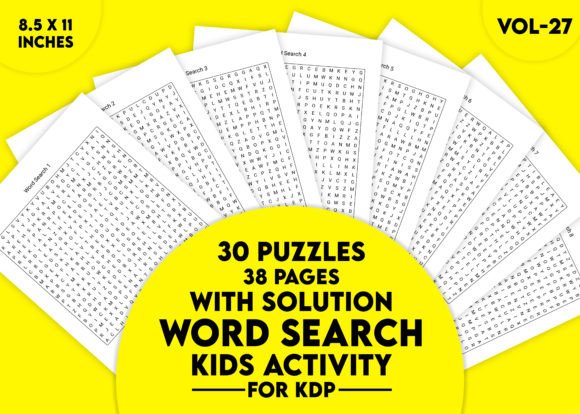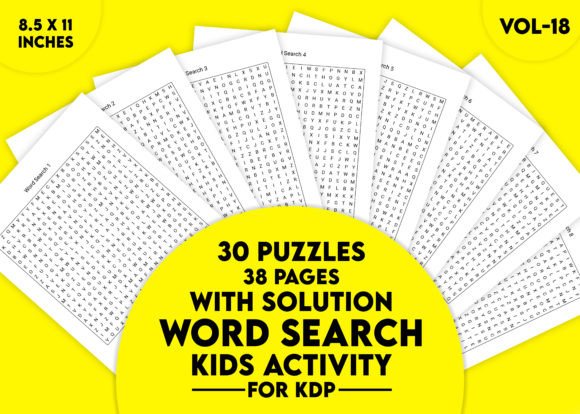
Word Search Kids Activity for KDP Vol 18
A word search puzzle is one of those rare activities that feels like play but quietly builds real skills. With Word Search Kids Activity for KDP Vol-18, you get thirty carefully designed puzzles that go beyond simple letter hunting. Each grid challenges kids to find words hidden horizontally, vertically, diagonally, and backward, turning every page into a small discovery mission. What makes this volume particularly useful is the thoughtful balance between variety and structure. The puzzles span different themes and difficulty levels, so a young solver never feels bored or overwhelmed. And because solutions are included, children can check their own work and learn from any missed words.
The format itself is built for real-world use. At 8.5 x 11 inches, each puzzle is large enough for small hands and tired eyes. One puzzle per page keeps focus sharp, while four solutions per page make answer checks quick and clutter-free. Whether you are a parent looking for quiet weekend activities, a teacher assembling lesson plans, or a publisher preparing a new release, this volume offers a ready-to-use resource that respects both the solver’s time and your own.
What Makes This Volume Stand Out for Creators and Educators
If you have ever tried to design a puzzle book from scratch, you know the challenge. Each grid must be error-free, each word list must match a theme, and the difficulty must be just right. Word Search Kids Activity for KDP Vol-18 removes that guesswork. The puzzles are already polished and formatted, so you can focus on the bigger picture: how to use them effectively.
For KDP publishers and small business owners, this volume is a turnkey asset. The PDF file is ready to upload, which means you can skip the tedious layout work and spend your energy on marketing, cover design, or building a series. Because the puzzles are family-friendly and age-appropriate, they fit comfortably in the children’s activity niche, one of the most consistent categories on Amazon. You can offer this as a standalone product or bundle it with other volumes to create a subscription-style collection.
For educators and homeschool parents, the value lies in the flexibility. A word search can introduce spelling words, reinforce vocabulary from a science unit, or simply provide a calm transition activity between lessons. The different difficulty levels mean you can hand a simpler puzzle to a first grader and a more complex one to a third grader, all from the same book. No extra prep, no modification needed.
Creative Applications Beyond the Obvious
Most people see a word search and think “quiet time filler.” That is a valid use, but it sells the format short. With a little imagination, Word Search Kids Activity for KDP Vol-18 can become a springboard for richer learning and play.
1. Vocabulary Building with a Twist
Instead of simply circling words, ask kids to write down each word after they find it and then use it in a sentence. This adds a literacy layer without feeling like extra work. For English language learners, the visual repetition of seeing the word in the grid helps reinforce spelling and recognition. You can even turn it into a game: whoever finds the most words and creates the most creative sentence wins a small prize.
2. Themed Learning Units
Because the puzzles cover multiple themes, you can align them with classroom topics. If you are teaching a unit on ocean life, hand out a puzzle that contains sea-related vocabulary. If the theme is space, use the corresponding puzzle as a warm-up. This makes the puzzles feel intentional rather than random, and it helps students connect new vocabulary to a meaningful context.
3. Collaborative Challenges
Word searches are often seen as solo work, but they can become collaborative too. Pair up students and give each pair one puzzle and two different colored pencils. They take turns finding words and discussing strategies. This turns the puzzle into a communication exercise, and it builds patience and teamwork naturally.
4. Speed Rounds and Timed Challenges
For older or more competitive kids, add a timer. Set a two-minute limit and see how many words each child can find. Then let them finish the puzzle without time pressure. This adds excitement without creating frustration, because they know the full puzzle is still waiting for them at their own pace.
How Different Audiences Can Adapt the Puzzles
The same puzzle set can serve vastly different goals depending on who is using it. Understanding these adaptations helps you get the most out of the volume.
For Parents and Caregivers
You need activities that are easy to pull out at a moment’s notice. Print a few pages and keep them in a folder for restaurant trips, rainy afternoons, or sibling playdates. The included solutions mean you can quickly verify answers without having to solve the puzzles yourself. And because each page is self-contained, you can hand one to a child and get ten minutes of focused quiet time when you need it most.
For Freelance Designers and Content Creators
If you are a blogger or influencer in the parenting or education space, this volume gives you ready content. You can create a blog post featuring a few puzzles, show how to use them in different settings, and offer the full set as a lead magnet or printable download. The clean PDF format means you can extract pages easily without having to rebuild grids from scratch. For social media, film a quick video of a child solving a puzzle and explain the benefits of screen-free learning.
For Publishers and Small Business Owners
Your main concern is product quality and customer satisfaction. With Word Search Kids Activity for KDP Vol-18, you get a professional layout that is consistent and clean. One puzzle per page avoids the cramped look that cheap activity books suffer from. The 8.5 x 11 inch size is the standard for print-on-demand, so you won’t need to resize or adjust margins. And because solutions are included, you reduce the risk of negative reviews from parents who cannot verify their child’s work.
For Therapists and Child Development Professionals
Word searches can be part of cognitive training for attention, visual scanning, and persistence. The grid structure forces the brain to sort through visual noise and focus on patterns. For children with attention difficulties, a well-timed puzzle can serve as a calming anchor. You can adjust the difficulty to match the child’s current capacity, and the sense of completing a puzzle builds confidence over time.
Practical Tips for Getting the Best Results
Whether you are using this volume for personal enjoyment or commercial publishing, a few simple practices will improve the experience.
- Print on quality paper. If you are using these at home or in a classroom, heavier paper or cardstock holds up better to erasing and repeated use. For commercial products, choose a paper weight that feels substantial but stays affordable.
- Laminate reusable pages. For a classroom center or a car trip kit, laminate a few puzzles and use dry-erase markers. The same puzzle can be used multiple times, which saves paper and extends the life of the activity.
- Group puzzles by theme or difficulty. If you are compiling a larger book, arrange the puzzles so that easier ones come first and harder ones follow. This creates a natural progression and keeps early frustration low.
- Use the solutions strategically. Do not place solutions immediately after each puzzle. Instead, group them at the back of the book or on a separate page. This way, children are encouraged to try before peeking, but help is still available when needed.
- Pair puzzles with other activities. A word search works well as part of a themed packet that includes coloring pages, mazes, or writing prompts. This turns a single puzzle into a broader learning experience and adds perceived value for buyers.
Keeping Content Clear and Audience-Friendly
One of the strongest features of this volume is its clarity. The large format, single puzzle per page, and separate solution pages all contribute to a smooth user experience. When adapting or building on this content, aim for the same principle: make it easy to use without instructions.
Avoid overcrowding the page with decorative elements that distract from the grid. The words should be the star. Use a font size that is readable for children aged six to ten, and ensure the word list is placed where it is easy to reference while scanning the grid. If you add illustrations or borders, keep them minimal and consistent with the theme.
For yourself as a creator or publisher, consistency is a selling point. When customers pick up Word Search Kids Activity for KDP Vol-18, they know what to expect from each page. That reliability builds trust, and trust leads to repeat purchases and positive reviews.
Why This Volume Deserves a Place in Your Toolkit
The market for children’s activity books is crowded, but quality still wins. Word Search Kids Activity for KDP Vol-18 delivers a polished product that saves you time while providing genuine educational value. Whether you are a parent looking for screen-free entertainment, a teacher seeking a versatile classroom tool, or a publisher building a product line, this volume adapts to your needs without requiring extra effort.
The puzzles are more than busywork. They sharpen pattern recognition, expand vocabulary, and teach persistence in a low-stakes environment. And because the format is so clean and accessible, you can use them immediately, right out of the box. No formatting errors, no awkward layouts, no missing solutions.
In a world full of endless digital distractions, a well-crafted word search still holds its own. It is simple, it is effective, and when done right, it is genuinely fun. This volume gives you thirty chances to make that happen.